Build an AI agent when the job is unusual, you have someone to maintain it, and it gives you a real edge. Use a hosted agent when the job is common store work like support, reports and order questions, because the hard part isn't the first version. It's the access rules, testing, handoffs and upkeep that follow.
With tools like Zapier and n8n, you can have a working demo in an afternoon, so building looks cheap. A demo that answers one question is a long way from something you would let near customers. This guide compares your real options, including their published prices, and lists the work that tends to get left out of the estimate.
What are your options?
| Option | Best for | Who maintains it | Main limit |
|---|---|---|---|
| Zapier | Connecting many apps with little technical work | Whoever built it, plus Zapier | Costs grow with usage; you still design the rules and safeguards |
| n8n | Technical teams who want control or self-hosting | Your team, especially when self-hosted | You own hosting, updates and security if you self-host |
| Custom code | Unusual jobs that give you an edge | Your engineers, indefinitely | Highest ongoing cost |
| Hosted agent for your kind of business | Common work that needs store data and channels | The vendor, plus your instructions | You work within what the product offers |
What do Zapier and n8n cost?
| Product | Plan | Published price | What it includes |
|---|---|---|---|
| Zapier | Free | $0 | 100 tasks a month |
| Zapier | Professional | From $19.99/mo billed annually, $29.99 monthly | 750 tasks a month at that price |
| Zapier | Team | From $69/mo billed annually, $103.50 monthly | 2,000 tasks a month at that price |
| n8n | Community (self-hosted) | Free license; you pay for hosting | You run it yourself |
| n8n | Starter | €20/mo billed annually | 2,500 workflow executions a month |
| n8n | Pro | €50/mo billed annually | 10,000 workflow executions a month |
| n8n | Business | €667/mo billed annually, self-hosted | 40,000 workflow executions a month |
The two count differently. n8n charges per run of a whole workflow, regardless of its step count. Zapier counts tasks, and it bills Zapier Agents in separate units called activities: its pricing page lists 400 a month on Free and 1,500 on Pro. Work out your own volume before you compare.
For reference, Concierge Starter is $20 a month with 20,000 credits, and Pro is $199 a month or $1,990 a year with 199,000 credits. Phone and text charges are billed as used. See what an AI employee costs for how to compare pricing models.
What does building actually involve?
The license is usually the smallest cost. Here's what a store-ready agent needs, whichever way you get it:
- Store actions: Reading orders is the easy part. Safely changing an order or subscription takes care with edge cases.
- Customer verification: Before sharing private order details, the agent must confirm who it is talking to.
- Channels: Chat, email, text and phone each bring their own setup, rules and failure cases.
- Memory: It should remember each customer and what your team taught it, and let you erase what it learned.
- Rules for actions: Decide what runs on request, what asks first and what is never allowed, then enforce that in the system, not just the prompt.
- Handoff: When a person steps in, they need the whole story, and the agent must step back.
- A record of every step: You need to see what it read and did, for debugging and for trust.
- Testing: Each change to a prompt or model can change behavior somewhere else. You need a way to find out before customers do.
- Upkeep: Models change, app connections break and APIs get updated. Somebody has to notice and fix it.
When should you build your own AI agent?
- The job is unique to your business and gives you a real edge.
- You have an engineer who will own it after launch, not just build it.
- Your data or rules must stay in systems a vendor can't reach.
- No product does the job, and you have checked.
- The job is simple and internal, and a mistake costs little. An n8n flow that summarizes a report is a sensible build.
When should you use a hosted agent?
- The job is common store work: order questions, returns, reports or subscription changes.
- It talks to customers, where mistakes are public.
- Nobody on your team wants to maintain it.
- You need several channels with one memory of each customer.
- You would rather spend engineering time on your product.
A hosted agent has real downsides too. You depend on a vendor's roadmap, you may not be able to change how a particular step works, and you need to check how they handle your data. Our data privacy guide lists the questions to ask.
Should you use fixed automation instead?
Often, yes. If every step is known and no judgment is involved, you may not need an agent at all. "When a new order over $500 arrives, post it in Slack" is a job for a workflow, and it will be cheaper and more predictable. Save agents for work that involves deciding what to do next. See Shopify Flow vs an AI agent.
Can you do both?
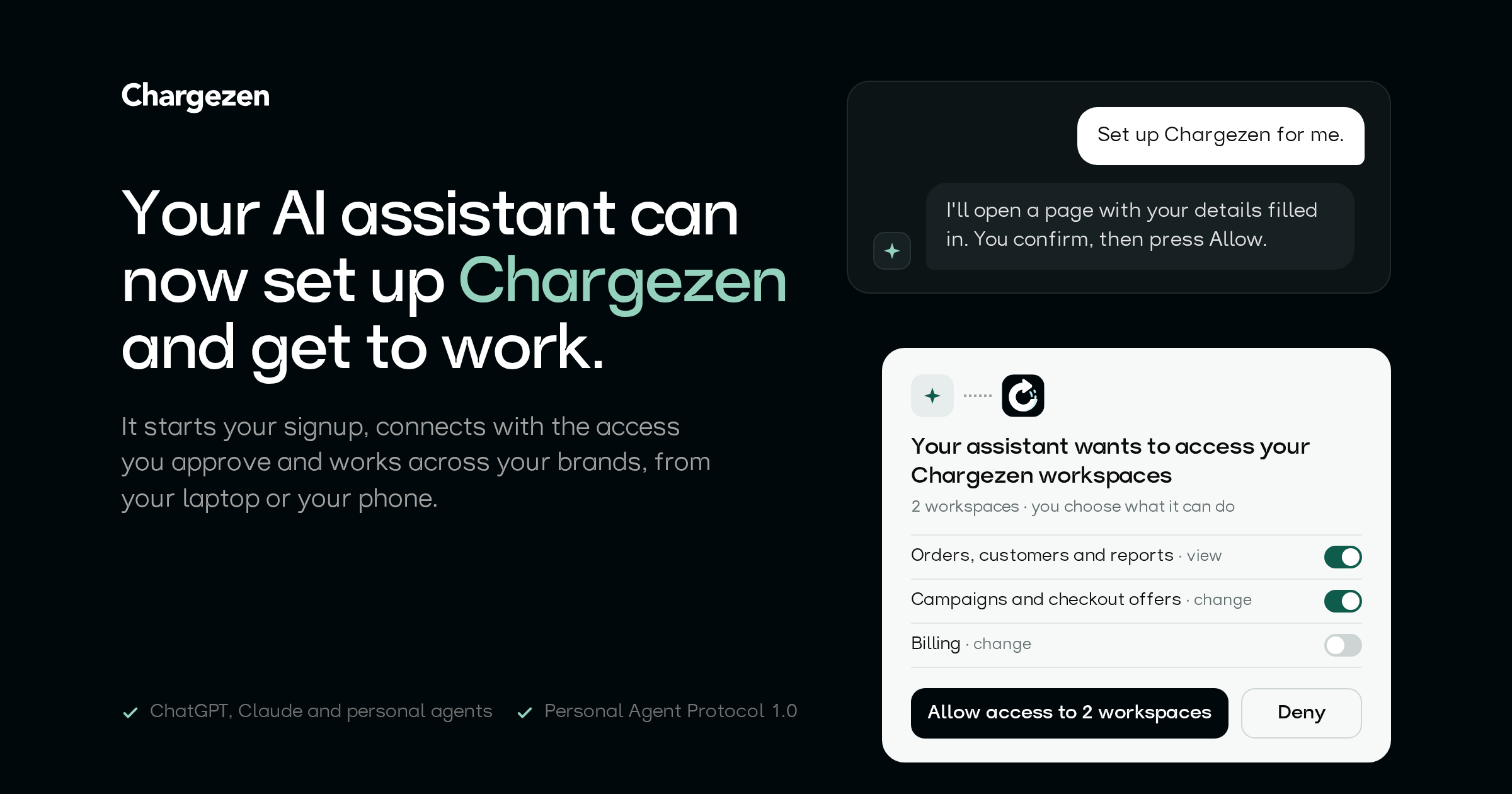
Many teams do. Use a hosted agent for common work and keep a few small automations for specific needs. If your team already works in an AI assistant, you can also connect it: Chargezen has an MCP server that lets assistants such as ChatGPT and Claude work with your workspace, under the permissions of the teammate who connected them. Our guide on connecting tools to an AI agent explains how.
A checklist for deciding
| Question | Points toward building | Points toward a hosted agent |
|---|---|---|
| Is this job common among stores? | No, it's unusual | Yes |
| Does it talk to customers? | No, internal only | Yes |
| Who fixes it at 9 p.m. during a sale? | An engineer we have | We don't have that person |
| Does it need to change orders or subscriptions? | No, or we have done this before | Yes |
| How much is an engineer's time worth elsewhere? | Little else is more valuable | They have more valuable work |
| Are there data rules a vendor can't meet? | Yes | No, after checking |
To estimate your cost of building, count the hours for the first version, then add a monthly figure for upkeep. Include your engineer's rate, hosting and model usage. Compare that with a vendor's price at your real volume. Test both on the same set of real requests if you can.
What should you test in a pilot?
Before you commit either way, run a small trial with the same real requests on each option. Score the things that tend to go wrong later:
- A request that changes something: See what stops it from acting on the wrong order.
- A customer who can't prove who they are: Private details should stay private.
- A failed connection: Turn off a tool mid-test and see what the agent tells the person.
- A handoff: Check that a teammate gets the whole story.
- A change to the instructions: Note how long it takes, and whether something else broke.
- A review of the record: Find out how quickly you can see why it did what it did.
How Concierge helps
Concierge includes the parts listed above: Shopify actions, every channel, memory, approvals and an audit trail and human handoff. If you already have an agreement with an AI provider, you can run agents on your own model account.
Keep reading: build or buy an AI voice agent, general AI agents vs support agents and what agentic AI is. Glossary: AI agent, bring your own key and AI guardrails.
Frequently asked questions
Should I build or buy an AI agent?
Buy when the job is common store work or talks to customers, and build when the job is unusual, gives you a real edge and has someone to maintain it. The first version is rarely the main cost. Upkeep, testing and safety usually are.
Can I build an AI agent with n8n or Zapier?
Yes. Both can connect AI models to your apps, and they suit internal jobs well. You remain responsible for customer verification, rules on actions, testing and fixing what breaks, so plan for that before you put one in front of customers.
Is self-hosting n8n free?
n8n's docs say that without a license key it runs as the free Community edition, checked November 1, 2026. You still pay for hosting and AI model usage, and for the time it takes to keep it running and secure.
Do I need an AI agent, or just an automation?
If every step is known in advance and no judgment is involved, an automation is usually cheaper and more predictable. Choose an agent when the next step depends on what it finds, such as a request that could go several ways.
Written by
Daniel Foster
Revenue Operations Lead, Chargezen
Daniel leads revenue operations at Chargezen, and writes about how businesses are applying AI agents to revenue-generating and revenue-supporting operations. His writing spans sales enablement, billing support, payment operations, customer onboarding, and the automation of complex business workflows. He is particularly interested in how AI systems connect existing software, interpret business data, and execute tasks across the customer lifecycle, helping organizations reduce manual work while creating more consistent customer experiences.